


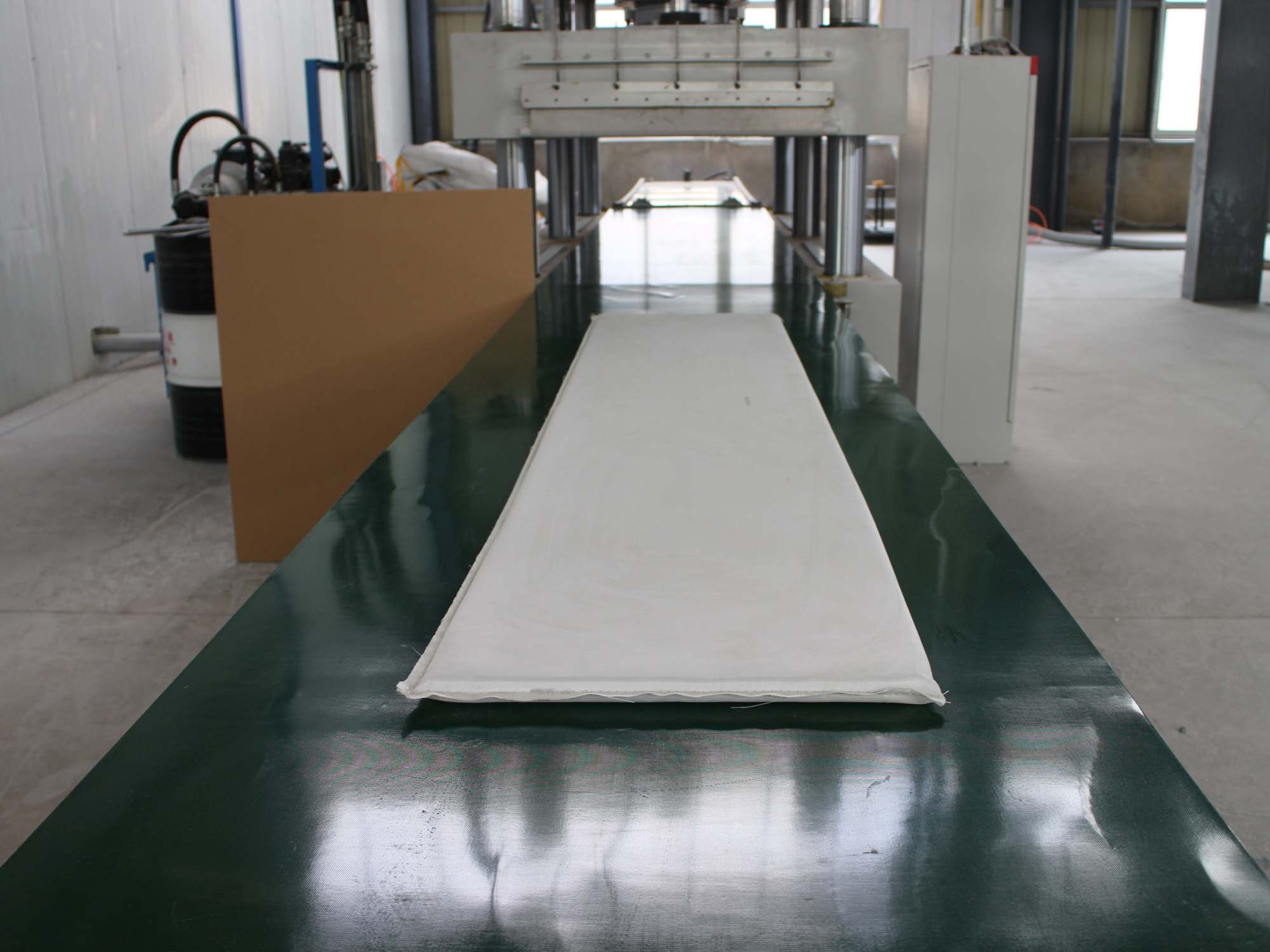
Microporous Board For Fireproof | MIP-950FP
| Color: | Grey |
|---|---|
| Classification Temperature: | 950℃ |
| Main Composition: | SiO2, SiC |
| Typical Density: | 280kg/cm3 |
| Compression Strength (10% deformation): | ≥0.3MPa |
Brief of Microporous Fireproof Board
Microporous Fireproof Board features a durable glass cloth outer envelope for cleanliness and ease of handling. The core is a specialized opacified blend of pyrogenic silica reinforced with filaments, ensuring excellent insulation performance. These boards are designed with precision for elevator landing and lift door systems, providing A-class fire rating solutions. Their robust construction meets high safety standards without compromising on environmental sustainability. With an emphasis on safety and environmental sustainability, Firebird’s microporous boards are suitable for a range of applications where fireproofing is essential, while also being easy to install.

- Technical Parameters
| Grade | Unit | MIP-950 FP | |
| Color | Grey | ||
| Classification Temperature | ℃ | 950 | |
| Main Composition | SiO2 | ||
| SiC | |||
| Typical Density | kg/cm3 | 280 | |
| Compression Strength (10% deformation) | MPa | ≥0.3 | |
| Shrinkage, full soak @ (°C*12h) | % | ≤2 (950) | |
| Shrinkage, one side @ (°C*12h) | % | ≤0.5 (950) | |
| Thermal Conductivity | 200℃ | W/m.K | 0.021 |
| 400℃ | 0.024 | ||
| 600℃ | 0.028 | ||
| 800℃ | 0.034 | ||
| Standard Sizes | L* W: | mm | 2800*780 |
| Thickness: | mm | 5-50mm | |
| Dimension Tolerance | Length and width direction: ±3mm: | ||
| Thickness direction: ±1mm | |||
| Covering | fiberglass cloth-covered | ||
Key Features of Microporous Fireproof Board
Environmental Safety and Non-combustibility: It is non-combustible, containing no flammable components, and does not release any harmful substances to humans or the environment during fire combustion, making it a green, environmentally-friendly, and safe insulation material.
Superior Insulation Performance: Due to its unique nano-structure and additives, it offers excellent insulation by minimizing all forms of heat transfer, including convection, conduction, and radiation. As the temperature rises, it maintains a thermal conductivity even lower than that of static air, showcasing outstanding insulation capabilities. Unlike traditional insulation materials such as silicate ceramic fibers or calcium silicate, which see a rapid increase in thermal conductivity with temperature, this material maintains superior insulation.


Key Features of Microporous Fireproof Board
Thin and Lightweight Insulation Efficiency: It is thin and lightweight, requiring only 1/4 to 1/6 of the thickness of traditional insulation materials to achieve the same effect. For example, at a flame temperature of 1160°C, a 25mm thick insulation board keeps the back surface at 128°C, well below the national standard of 140°C, meeting thermal flux requirements. This allows fire-insulated elevator doors to be as thin as regular doors, offering significant design convenience. In contrast, ceramic fiber insulation would need a thickness exceeding 100mm to achieve the same back surface temperature.
Structural Integrity: The insulation board has structural integrity, with a certain strength and a non-combustible glass fiber cloth covering, ensuring cleanliness and dust-free usage. During normal elevator operations, it retains its structural integrity. In the event of a fire, although the glass fiber covering may become brittle, shrink, or even melt under high temperatures, the core material itself maintains its integrity and insulation performance.
Application of Microporous Fireproof Board
The Microporous Fireproof Board is widely used in a variety of high-performance fire protection applications due to its excellent thermal insulation and non-combustible properties. It is ideal for Passive Fire Protection (PFP) systems, which are essential for controlling the spread of fire and protecting critical structural elements in buildings. In such systems, the board acts as a reliable barrier that withstands high temperatures and prevents heat transfer, ensuring fire safety compliance in various sectors.
Additionally, elevator landing doors benefit from the unique properties of the Microporous Fireproof Board, allowing them to maintain a slim profile while still offering robust fire resistance. This characteristic is particularly advantageous in architectural design, as it enables fire-rated elevator doors to match the thickness of standard doors without compromising on safety.
Furthermore, industrial fire doors are another key application area, where the board’s lightweight and efficient insulation qualities provide significant advantages. These doors are critical in industries that require high fire resistance, as they help contain fire within specific areas and protect personnel and equipment. The board’s durable construction and reliable insulation properties make it a preferred choice for manufacturers seeking advanced fireproofing solutions in industrial environments.


What makes microporous board thermal conductivity lower than still air?
Microporous insulation products utilize their distinctive nanoporous structure and the combined effects of multiple additives to effectively minimize heat transfer through conduction, convection, and radiation over a broad temperature range. This exceptional performance puts them ahead of traditional insulation materials like mineral wool, perlite, insulating bricks, calcium silicate, ceramic fibers, and even aerogel blankets. In many temperature ranges, microporous insulation has a thermal conductivity lower than that of still air.
Key characteristics and advantages of microporous insulation include:
- Nanoscopic Structure: The tiny particle size reduces surface contact, drastically cutting down heat transfer via conduction.
- Nanoporous Design: With pore sizes around 20nm, gas molecules are trapped, virtually eliminating internal convection.
- Infrared Blocking: The addition of infrared-reflective powders blocks and reflects radiant heat, especially at high temperatures, further decreasing heat transfer.
These combined attributes make microporous materials highly efficient for thermal insulation, delivering unmatched performance in a variety of industrial and high-temperature environments.
Related Products
Firebird offers a range of products including rigid boards & panel, flex felts & blanket, custom shapes, and granules, each differing in fabrication method to cater to diverse working environments and specific application needs.


Why Choose Firebird?
At Firebird, we focus on one thing: delivering reliable refractory materials to our customers. To learn more about our refractory products, please visit our main website.
We have built a network of trusted manufacturers, and we use our experience to ensure that the products you receive meet your standards, every time. Our goal is to ensure you get the right materials at the right time, without complications.
Absolutely! We welcome plant audits and visits to our facilities. Please note that Firebird insulation refractory and high-performance refractories are manufactured in separate plants. Let us know your requirements, and we can arrange a convenient schedule for your visit to ensure a smooth and informative experience.
Yes, we provide free samples for testing purposes. However, customers are responsible for covering the courier charges associated with shipping the samples.
Our standard delivery time is generally between 10 to 15 days for most products. However, for specialized or customized bricks, the delivery time may extend to approximately one month. We strive to meet our customers’ timelines and will provide an estimated delivery date upon order confirmation.
We focus on transparency and quality at every step. After your order is placed, we:
- Share a detailed production plan.
- Provide weekly progress updates.
- Deliver a comprehensive test report for each batch.
- Carefully inspect the appearance, size, and weight of every product.
- Send shipment photos to keep you informed throughout the process.
This ensures complete visibility and trust in our manufacturing process.
We accept payments via T/T (Telegraphic Transfer) in major currencies such as Euro (EUR) and US Dollar (USD). Our payment terms are flexible, and we can accommodate different payment schedules based on the agreement.